
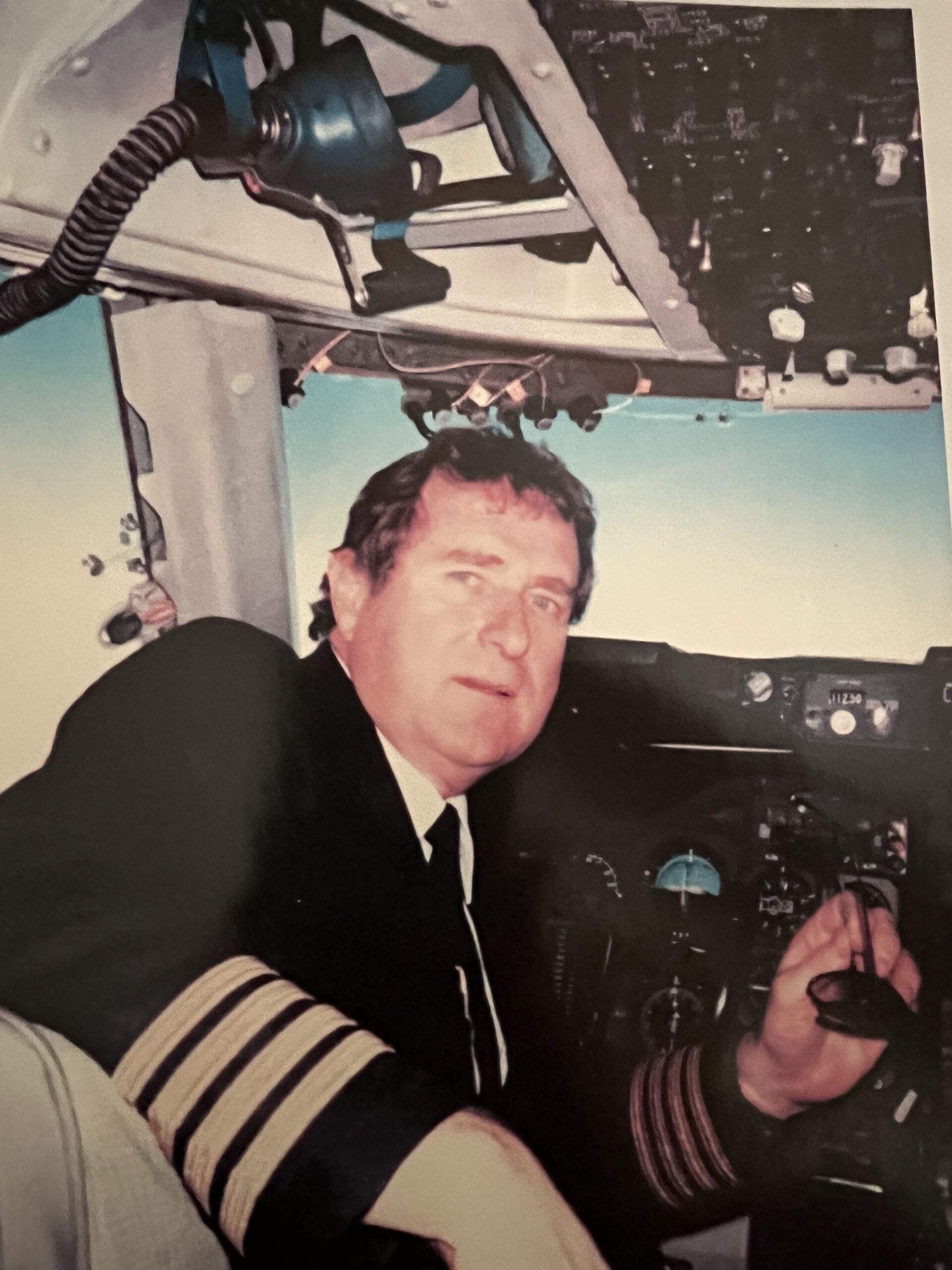
 Lt. Col. Henry “Hank” Edward Hieftje, USAF (Ret.)
July 23, 1931 – July 7, 2026
It is with deep sadness and a little disbelief that we announce the death of a larger-than-life spirit, Henry “Hank” Edward Hieftje, on July 7, 2026, in Lady Lake, Florida, just sixteen days short of his ninety-fifth birthday.
Hank liked to be addressed simply as “Colonel,” and lived many lives in his long life: a United States Air Force pilot and navigator, a Pan American World Airways and United Airlines pilot, a gifted athlete and artist, a farmer, a builder and a world traveller. He was also a beloved husband and stepfather, with many friends dispersed widely around the world.
Hank was born in New London, Connecticut, to Mary Eleanor Patz Hieftje (1910-2007) and Henry “Hank” John Hieftje (1905-1986). His family moved to Torrington, Connecticut, in 1935 as his father’s HVAC business grew. Hank’s happiest school memories were formed at The Frederick Gunn School—then known as The Gunnery—from which he graduated in 1950 and for which he later served as class agent.
Hank joined the United States Air Force in July 1952. After basic training at Sampson Air Force Base in New York’s Finger Lakes region, he completed navigator training at Harlingen Air Force Base in Texas and was commissioned as a second lieutenant in January 1954. He married Dorothy Douglass of Brownsville, Texas, in 1954, and they were posted to RAF Molesworth in England.
Upon their return to the United States, Hank completed primary pilot training in Bartow, Florida, and advanced training at Lubbock Air Force Base in Texas. His 26-year Air Force career also included service with the Strategic Air Command’s 509th Bombardment Wing at Pease Air Force Base in New Hampshire, Air Rescue Service at Kindley Air Force Base in Bermuda, and the New Hampshire Air National Guard. He retired with the rank of lieutenant colonel.
During his military career, Hank flew the T-34, T-28, B-25, B-29, KC-97, C-97, RC-97, C-124 and C-130. He remained connected to the fellowship of military aviators throughout his life and was a life member of the Order of Daedalians.
On August 1, 1966, Hank joined Pan American World Airways. Over the next twenty years, he flew the Boeing 707, Lockheed L-1011 TriStar and Boeing 747-100 around the world. Pan Am became one of the defining adventures of his life. He later joined United Airlines, where he continued flying the 747-100 until retiring from commercial aviation in 1996.
Hank earned a bachelor’s degree from Johns Hopkins University along the way, but flying was his first and abiding love. He referred to the 747 cockpit as his “office.”Pan Am was one of the world’s most remarkable professional communities during the golden age of commercial aviation, bringing together pilots, flight attendants and employees whose work quite literally spanned the globe. “The world is our oyster,” they would say—with good reason.
Among the passengers Hank encountered during his twenty years with Pan Am were Richard Burton, Elizabeth Taylor, Maggie Smith, Rock Hudson, Audrey Hepburn, Flip Wilson and many other celebrities and notable figures of the day. He spoke with gusto of remarkable meals in Buenos Aires, New Delhi, Tokyo, Moscow and elsewhere. He remembered the Russian MC introducing Duke Ellington and his orchestra in the audience at the opening of a Bolshoi Ballet performance in Moscow. Ellington’s band had been passengers on one of Hank’s flights.
Hank was a prodigious athlete. He had a proud memory of being able to consistently cup a basketball in one hand in hishad youth. He skied for the Pan Am ski team and had often mapped out his early-morning jogging route before unpacking his bags at a new hotel. He was also a builder and steward of old places. With Dorothy, he bought and renovated farms in South Berwick, Maine, and later took on a colonial home built in 1768 in Milton, New Hampshire.
In retirement, Hank and his second wife, Jean Hope Hale, moved to Italy, where they lived for more than twenty years. At the age of seventy-two, while studying at the Angel Academy of Art in Florence, Hank rediscovered his latent artistic talent and pursued it with characteristic passion and discipline. He produced dozens of oil paintings, as well as charcoals and watercolors in a remarkably short time. Hank insisted that sculpture was his true calling, but the legacy of paintings he left behind suggests otherwise.
Hank later met and married Canadian-born writer Margot MacPherson Brewer. Their years together were filled with building projects, travel, animals, old houses, improbable plans and a shared delight in making life larger than either had imagined it alone.
Hank’s life straddled convention and adventure—drawn equally to the reliability of a flight plan and the exhilaration of departing from it. He regularly and easily recounted hundreds of stories from his years of flying and international travel. By his own account, he was occasionally mistaken for “the most interesting man in the world” from the Dos Equis TV advertisements. To which, Hank would reply slyly, “That wasn’t me. I am just the second most interesting man in the world.”
Hank was a commanding presence in any room he entered and could occasionally be gruff. Beneath that veneer was the generous and loving heart of a man who was a force of nature. Hank was game for almost anything, and his appetite for life seemed boundless. With Margot, he appeared to find something of the two worlds he craved: the solidity of a loving marriage and a co-conspirator open to yet another madcap adventure. Margot offered imagination; he climbed aboard. Together they created a space where their mutual need for home and hunger for distant horizons could coexist. On the cusp of his ninety-first birthday, Hank was rightly impressed with his prowess at cod jigging in the bay off Cavendish, Newfoundland.
Hank will be remembered for the broad sweep of his life and his place in commercial aviation’s golden age. He would often say, emotionally: “I love my country.” The United States shaped and educated him, and he expressed his devotion through twenty-six years of military service and a worldview formed from the cockpit. Above all, Hank’s curiosity, resilience and appetite for life stayed with him for nearly ninety-five years.
Hank was predeceased by his parents, Hank, Sr. and Mary, and by his younger sister, Donna (1933-2022). He is survived by his wife, Margot MacPherson Brewer; her children, his stepchildren, Katie and Cameron; two nieces and a nephew, Myra von Turkovich, Geof Tillotson and Amy Tillotson, all of Massachusetts, and many friends around the world, too numerous to name.
Hank’s body was donated to the University of Florida College of Medicine for medical education and scientific research. When his remains are returned, a funeral service with full military honors will be held and streamed online. Notice and details of the service will be shared in advance. Those wishing to honor Hank’s memory are invited to make a donation to any service organization dedicated to supporting veterans.
Written memories and photographs of Hank are warmly encouraged and may be shared on the memorial website Forever Missed, created in his honor: https://www.forevermissed.com/hank-hieftje/about